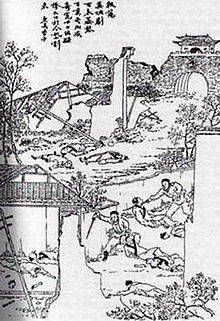
This is an image of the Yangzhou massacre, the pillaging and near extermination of an entire village in Southern China by the Manchu.
With all of the readings available, I decided to focus on the conquest set as I felt that would reflect the transition from the Ming to the Qing the best. One thing that struck me right away after completing the readings was how differently the Manchu were depicted from reading to reading. As in the chapter from “The Great Wall: China Against the World” while the Qing may have been depicted as barbarians and bandits towards the beginning of the book with their constant attacks on the walls of China but when the Ming were falling to the forces of Li Zicheng the Manchu seemed to be depicted as potential saviors. While the Manchu may have stopped the rule of Li Zicheng in Bejing their rule was not depicted as saviors which can be ascertained from their description in the chapter. As even after defeating Li Zicheng’s army they were still categorized as barbarians, this could have been due to their “uncivilized” nature compared to the haughty Ming or it could be due to the losers documenting the history and not having a favorable view of their own rulers. Inversely the Qing may have been depicted more positively than they may have should have been, this may be due to revisionist history by them as they were ruling China or just initial perception. But when you take into consideration the Massacre of Yangzhou by the Manchu they emphasize their status as barbarians and may even venture into the realm of savages due to the atrocities they committed.
Overall when comparing the Ming and the Ching there seem to be stark differences, but in the end, it appears that the Qing became somewhat like the Ming. The Qing appeared to be strong hearty people hardened by the environment of the North, the antithesis to the pompous and fattened Ming from the South, the Ming also appeared to have moved away from their agrarian basis for society and shifted toward wealthy towns and cities. The Qing on the other hand were nomads, a large difference from the Ming at the time of their conquering. Considering all these differences and the Qing’s apparent distaste for the management and actions of the Ming there is a very large question in place. If they were so starkly different in culture and held such contempt towards the Ming why were the Qing so ready to adopt the bureaucracy and ways of the Ming in the face of their failure?
Sources:
Lovell, Julia. The Great Wall: China against the World, 1000 BC-AD 2000. 1st paperback ed. New York: Grove Press, 2007.
Mitter, Rana. Modern China: A Very Short Introduction. Very Short Introductions. Oxford: Oxford University Press, 2008.
“Nurhaci’s Seven Grievances”. In The Search for Modern China: A Documentary Collection. Third edition. Edited by Janet Chen, Pei-Kai Cheng and Michael Lestz, with Jonathan Spence, 19-21. New York: W.W. Norton and Co., 2014.
Spence, Jonathan D. The Search for Modern China. First ed. New York: W.W. Norton & Company, 1999.
Struve, Lynn A. Voices from the Ming-Qing Cataclysm: China in Tigers’ Jaws. New Haven: Yale University Press, 1993.
“Two edicts concerning hair”. In The Search for Modern China: A Documentary Collection. Third edition. Edited by Janet Chen, Pei-Kai Cheng and Michael Lestz, with Jonathan Spence, 19-21. New York: W.W. Norton and Co., 2014.

This past week a read exploration pack 1 which gives the transition between the Ming and Qing from just one perspective, so I was interested to see when reading your post that there are in fact many ways that they were depicted which makes sense I guess as there are so many different people recounting their version of the history.
In my personal opinion I think that the Qing may have started out as a more barbaric nation as it conquers nearing regions, some of which weren’t posing any threat to them. However, as the decades pass and the Qing finally become the rulers of the Ming dynasty it seems that they adopt a more “civilized” approach which seems to be reflected in some way at the end of your post when you talk about the Qing adopting the Chinese bureaucracy. I personally found this rather impressive of the Qing rather than a downfall as it seems like they realized that they didn’t have the strength to abolish the entire system and start over. Rather hold on to the current system which is functioning reasonably well and reap its benefits for yourself.