Exploration Pack 2: The Great Leap Forward (into famine)
I would say I struggled overall with this week’s materials not because I found them confusing or found them difficult to read but rather because I found them difficult to comprehend what I was hearing and reading. While on the surface The Great Leap Forward was a good goal and idea but the actual implementation of it and the actions that were taken to ensure these artificial goals and quotas were met are mind-boggling to read about. I think it is unfair to solely place the blame on Mao, while it was his ideas and his economic ideology that was behind The Great Leap Forward and it was his god-like stature that was used to push it and he was put on record saying he was willing to sacrifice the lives of millions of peasants to push China forward solidifying his place as a mass murderer. Some of the blame should be placed on the communist party overall and the local cadres that oversaw the communes but the Mao should not be held anyless acoutnable because of this. The push for party recognition for organizing a high producing commune that supplied lots of grain to the state seemingly superseded the needs and will of the people, overstating harvests resulting in a higher state grain tax decimated some communes but gave the cadres running such communes status within the party. Ultimately, betraying the founding principles of the CCP to be for the people, especially the working class.
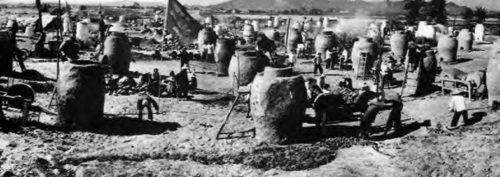
On top of this poor handling of the agricultural communes and their resources resulting in widespread famine and death, there was the issue of the steel production of China. As a part of The Great Leap Forward Mao made a promise that the steel production of China would surpass Britains and catch up to the US in 15 years, a seemingly impossible goal. China did not possess the infrastructure of railroads and factories to actually support this goal so the solution was the encouragement of people in the countryside to make their own blast furnaces with whatever they could find and smelt their own iron and steel. This backyard melting went as well as one would assume with the amateur alloy smelters making essentially useless metal that was riddled with impurities and could not be functionally used for almost anything. But as a result of this encouragement the landscape of rural China was decimated as people went to cut down trees in order to fuel their furnaces, additionally, families had to give up their iron such as pots and pans to be smelted down into the metal.
Overall the readings for this week made me a little angry as the loss of life, which has reasonable estimates ranging from 30-45 million people was completely and utterly avoidable if the focus was on improvement and not on filling arbitrary goals. These goals led to the fabrication of harvest numbers and misuse of resources that resulted in millions having their lives destroyed or ended. The only remote positive of the materials of this week was the children’s story of Gousheng and the Iron Child but the positive is underlined by sadness. As this child who was essentially abandoned by the commune system turns to a life of eating iron and rummaging around scrap iron piles with his friend the Iron Child, even abandoning his mother and father once he finds them, the fact that is seen as. superior lifestyle is disheartening and a good example of the damage The Great Leap Forward inflicted.
Bibliography:
Mio, Arturo, Dérives (Firm), and Radio-Télévision belge de la communauté culturelle française. Mao’s Great Famine. Filmakers Library, 2012.
Mo Yan. “Iron Child”, in Shifu, You’ll Do Anything for a Laugh.
Spence, Jonathan D. The Search for Modern China. Third ed. New York: W.W. Norton & Company, 2013.
