Through the first half of the 1930s, a brutal war of propaganda and man hunting was taking place between the Chinese Communist Party (CCP) and the Nationalists or Guomindang who were in power at the time. The Guomindang was led by Chiang Kai-Shek, the Commander in Chief of the Nationalist Revolutionary Army which he led during the Northern Expedition. During this expedition, Chiang defeated the warlords of the area and seemingly unified China again under the banner of the Nationalist party. This was not done by Chaing himself, the Nationalists had the support of the CCP at the time, the reunification of China was a joint effort by both parties in order to reclaim China from the warlords of the North. Before reunification was established Chaing turned on the Communists within the alliance and aimed to purge them from China, ultimately failing and beginning an extensive civil war that would last until 1936. Chiang attempted to destroy the communists in Jiangxi and Fujian but the communists escaped and began their infamous Long March, a journey that would characterize the CCP.
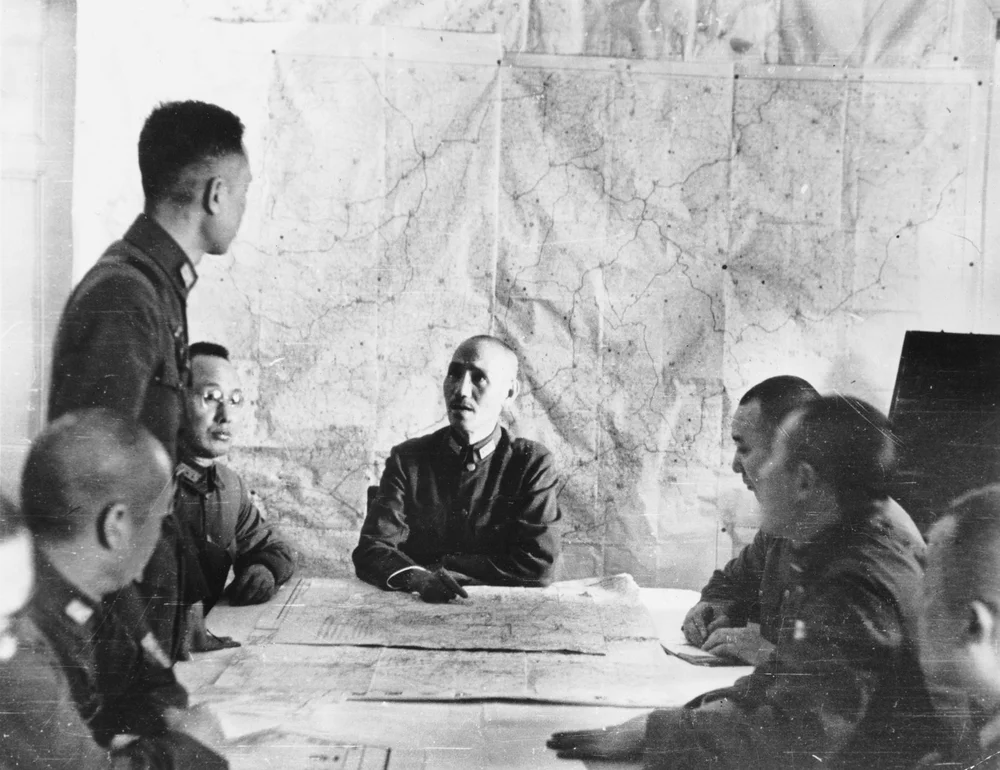
The betrayal was seemingly expected with hindsight due to the sowing of the seeds of Communism in the ranks of the Nationalists by the Communists, notable Communists such as Mao or Chou Enlai held high positions either in the government or the military. The expulsion of the communists and their subsequent hunting led to the Long March by the communists, a march lasting over a year that took the main portion of the Communist’s army and their party leaders from Yudu in Jiangxi to Yan’an in Shaanxi. This escape of the communists seemed to have almost clouded the view of Chaing Kai-Shek, his life was ultimately consumed with the complete defeat and expulsion of communism in China even when faced with a greater threat. Japan was creeping in on China, taking over Manchuria as a response to a “Chinese” terrorist attack that was staged by the Japanese. Japan’s pressure worried many Chinese, especially younger generations, the national fight against the Japanese started with student-led protests that demanded Japan’s aggressions to be addressed. These calls by the students were mimicked by that of the CCP, with the CCP declaring war on Japan before their second alliance with the Nationalists had even been established yet. But even with these calls the Nationalists, with Chiang Kai-Shek at the helm were slow to respond to the threat.
With the slow response to the Japanese threat by the ruling Nationalists, many became frustrated with the lack of action, even some within the Nationalist party, specifically Zhang Xueliang and Yang Hucheng who were frustrated with the use of their troops. They were frustrated that their troops were being used to fight their own countrymen, the communists, while there was a looming threat of the Japanese in the North of China, additionally the two men were sympathizers with the CCP. The result of their sympathies and their frustration was essentially a coup with the support of the CCP where their forces captured Chiang Kai-Shek while he was staying at the resort springs in Lintung. Chaing was captured on December 11th and taken to Xi’an where he would be held until late December. Once he was captured some of the board members of the CCP called for his execution, as they saw him as a traitor to China through his inaction and his hunting of the CCP, but this was dissuaded by Mao and the Soviets. As they saw no clear leader from the Nationalists besides Chiang that could guide the party through a war with the Japanese.
While being held captive Chiang was hesitant to cooperate with his captors, but this tension was broken by his wife who came to be with him in his captivity and by the diplomacy of Chou Enlai. The persuasion of Chiang’s wife goes past this as well, as she convinced the Nationalist government and some of Chaing’s opponents to not bomb Xi’an and instead find a diplomatic solution to the crisis. The negotiations essentially forced Chaing’s hand in creating a second alliance with the CCP, as with their reasoning, which was seemingly correct, the Nationalists could not sustain a two-front war between the CCP and the Japanese. Additionally, the CCP did not want to fight the Nationalists as they saw the Japanese threat as not one of simple loss of land but the loss of China’s sovereignty, an idea they soon convinced Chiang of as well. The deal was sweetened with Chou Enlai’s guarantee that he would have Chiang’s estranged son, who had been staying in Moscow with his Russian wife would be returned to him if he accepted an alliance with the CCP. The alliance was formally made on December 24th, 1936, this alliance forced the Japanese’s hand in their invasion of China beginning the assault in July of 1937 which would turn into a grueling and deadly confrontation.
Bibliography:
Crossland, John. “The Xi’an Incident.” History Today 37, no. 7 (1987).
Spence, Jonathan D. The Search for Modern China. Third ed. New York: W.W. Norton & Company, 2013.
